
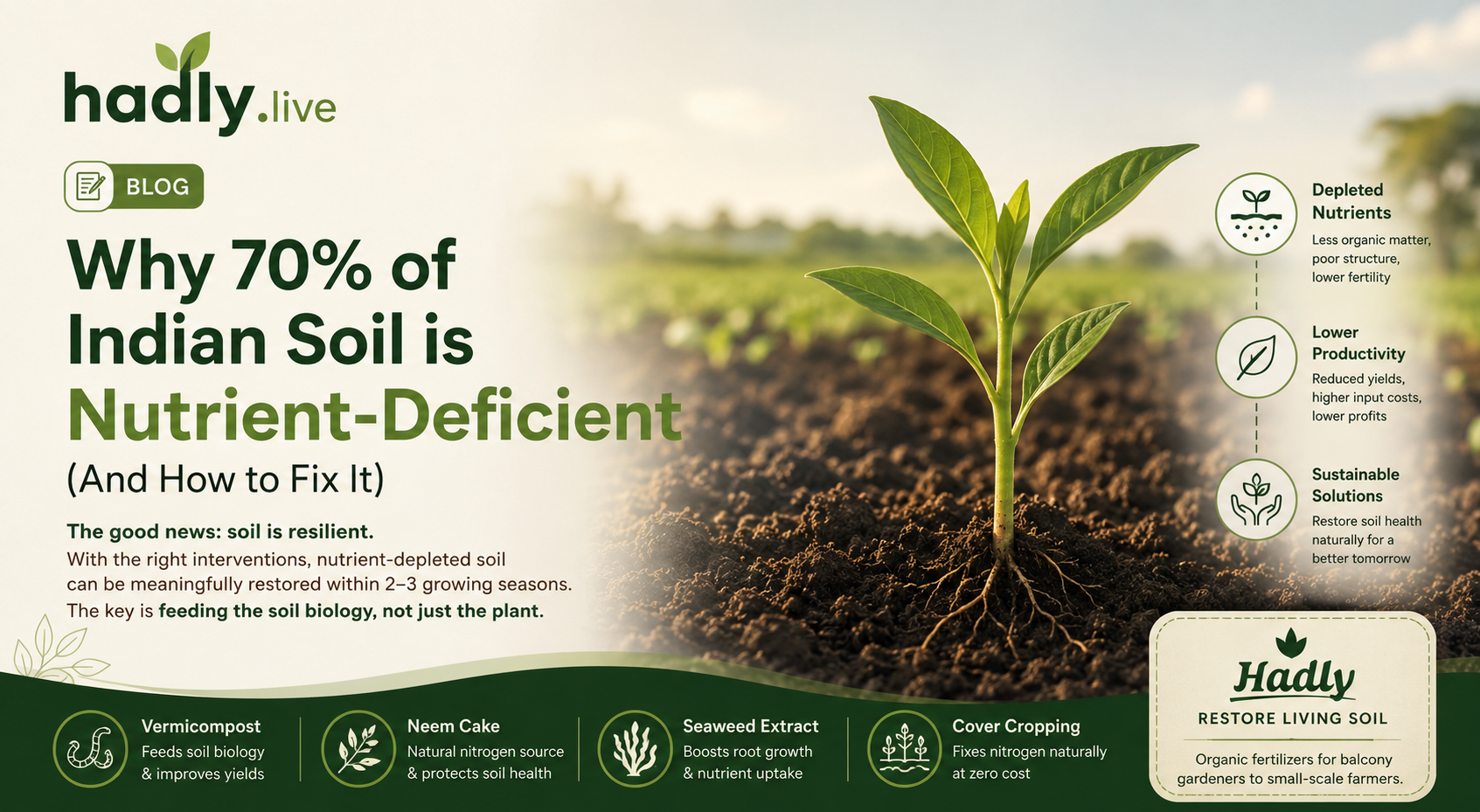
Walk through any agricultural field in India today and pick up a handful of soil. It should smell earthy, teem with life, and crumble apart in your hand. But increasingly, what farmers and gardeners find is dry, compacted, lifeless dirt — and a 2021 report by the Indian Council of Agricultural Research (ICAR) confirms the scale of the crisis: over 70% of India's cultivable soil is deficient in one or more macro or micronutrients.
How Did We Get Here?
The Green Revolution of the 1960s and 70s was a miracle in terms of food production. India went from a nation on the brink of famine to a grain exporter within a decade. But the miracle had a hidden cost. The high-yielding variety (HYV) seeds introduced during this era required heavy doses of synthetic nitrogen (N), phosphorus (P), and potassium (K) — what farmers call NPK fertilizers — to produce maximum yields.
Decades of NPK-only fertilization created a dangerous imbalance. While plants grew, the billions of beneficial microorganisms — bacteria, fungi, protozoa, nematodes — that make soil alive were slowly suffocated. Chemical salts raised soil pH in some regions and dropped it in others. Organic matter, which acts as the 'glue' that holds soil structure together, plummeted from the historical average of 2–3% down to below 0.5% in many Indian states.
"Healthy soil is not just dirt. It is a living ecosystem with more organisms in one teaspoon than there are people on Earth." — Dr. Elaine Ingham, Soil Biologist
The Vicious Cycle of Chemical Dependency
Here's the cruel irony: as soil health declines, yields drop. To compensate, farmers apply even more chemical fertilizer. But dead soil can't absorb nutrients efficiently — studies show that less than 30% of applied synthetic nitrogen actually reaches the plant. The rest leaches into groundwater or volatilises into the atmosphere as nitrous oxide, a greenhouse gas 300 times more potent than CO₂.
The result? Farmers spend more, earn less, and the soil degrades further. A 2023 survey by the National Bank for Agriculture and Rural Development (NABARD) found that 58% of small and marginal farmers reported declining yields despite increased input costs over the previous five years.
What Science Says About Recovery
The good news: soil is resilient. With the right interventions, nutrient-depleted soil can be meaningfully restored within 2–3 growing seasons. The key is feeding the soil biology, not just the plant.
✦Vermicompost introduces and feeds beneficial microbes, improves aeration, and boosts water retention — studies show 20–35% yield improvements over chemical-only inputs in the second season.
✦Neem Cake (neem oil cake) acts as a slow-release nitrogen source and a natural soil conditioner. It also suppresses harmful nematodes and soil-borne pathogens without harming beneficial organisms.
✦Seaweed Extract is rich in natural plant growth hormones (cytokinins, auxins), trace minerals, and alginic acid — which feeds mycorrhizal fungi that extend root networks exponentially.
✦Cover Cropping with legumes like cowpea or clusterbean fixes atmospheric nitrogen directly into the soil, adding 40–200 kg N/ha per season with zero cost.
What You Can Do Right Now
Whether you manage a 10-acre farm in Karnataka or a 2×3 foot balcony garden in Mumbai, the principle is the same: start returning organic matter to your soil. Even a single application of quality vermicompost will begin feeding the microbial ecosystem within days.
At Hadly, every product we make is designed around one idea — restoring living soil. Our vermicompost is sourced from certified organic farms. Our neem cake is cold-pressed. Our seaweed extract is wild-harvested from the Indian coastline. We don't believe in shortcuts, because the soil doesn't either.
Healthy soil → healthy roots → healthy plants → healthy food → healthy people. It all starts beneath your feet.